
Nissan Elgrand Hub



5 Surprising Secrets We Uncovered in the Nissan Elgrand's Service Manuals
Introduction: The King of Minivans Has a Hidden Life
The Nissan Elgrand, often affectionately dubbed the "King of Minivans," holds a special place in the hearts of Japanese Domestic Market (JDM) enthusiasts. Imported for its blend of luxury, space, and unique character, it offers an experience quite unlike any domestic people-mover. But this JDM heritage comes with a challenge: a scarcity of official English-language documentation. For years, owners have relied on community knowledge and trial-and-error to understand their vehicles' more esoteric features.
However, a deep dive into the original Japanese service manuals reveals a hidden world. These highly technical documents, designed for Nissan's domestic technicians, are a treasure trove of fascinating, user-focused, and sometimes downright strange secrets about the Elgrand's design and functionality. By deciphering these guides, we can see the incredible level of thought that went into every system. This article uncovers five of the most surprising discoveries found buried deep within the Elgrand's technical schematics and service procedures.
--------------------------------------------------------------------------------
1. A Polite Japanese Lady Lives in Your Dashboard
One of the most common and bewildering experiences for a new Elgrand owner is starting the vehicle for the first time, only to be greeted by a polite female voice speaking in Japanese. For those who don't speak the language, this can be an amusing but mysterious daily ritual. The service guides and owner FAQs quickly solve the mystery.
According to the "E51 beginners guide," this voice originates from the electronic road toll card reader, a standard feature in Japan that is often left in the vehicle when it's exported. She isn't just saying hello; she's likely "telling you the date & time and that you haven’t paid the toll bill." While the entire unit can be tracked down and unplugged to silence her permanently, there's a much simpler trick. The next time she speaks, simply use the stereo's volume control while she is talking to turn her volume down to zero. This is a classic example of the many JDM-specific features, like the DVD ROM or hard drive-based navigation, the Auto DJ, and the built-in telephone system, that are rendered useless outside of Japan but remain as quirks of the vehicle's past life.
--------------------------------------------------------------------------------
2. Your Van Has a Secret "Service Menu"
Beyond the usual warning lights on the instrument cluster, the Elgrand's audio-visual and navigation unit hides a powerful, integrated self-diagnosis system. The technical manual for the AV system details a "fault diagnosis function" that allows the user to access a hidden menu screen, turning the center display into a sophisticated diagnostic tool.
Accessing this menu is a simple but non-obvious sequence, straight from the manual: With the ignition on, press and hold the "画質" (Image Quality) button. While holding it, turn the driver's side "TEMP" knob several clicks until the service menu appears.
This secret menu can perform a self-diagnostic on all connected entertainment and navigation units, including the main control unit, the GPS antenna, and the TV tuner, and display the results right on the screen. The level of detail is impressive. The system even color-codes the diagnostic results to show error priority, with red indicating a more severe issue than yellow or ash. From this menu, an owner can access a surprising number of functions, including:
Viewing the complete error history of the AV system.
Checking the status of key vehicle signals in real-time—including vehicle speed, parking brake engagement, lights, and the reverse signal—which can be invaluable for diagnosing tricky electrical gremlins without specialized tools.
Adjusting the navigation system's angle and distance calibration, which is useful if the car's position on the map is consistently inaccurate.
--------------------------------------------------------------------------------
3. It Actively Tries to Save You From a Flat Battery
We've all done it: accidentally left an interior map light or dome light on overnight, only to wake up to a dead battery. The engineers at Nissan were clearly aware of this common problem and, according to the lighting system manual, built a clever solution right into the Elgrand's electronics. It's called "battery save control," and it's a wonderfully thoughtful piece of user-focused engineering.
The function is simple yet effective. If the key switch is in the OFF position and any interior light—such as a map lamp, room lamp, or step lamp—is left on, the system waits. If there are no changes to the lighting state for 30 continuous minutes, it assumes the light was left on by mistake and automatically turns off all interior lamps to prevent the battery from draining. The system is also intelligent enough to know when you're actively using the lights. The 30-minute timer resets if the state of any lamp changes, such as turning one light off while another remains on, or turning a new light on. It’s a small, hidden feature that solves a very common and frustrating problem.
--------------------------------------------------------------------------------
4. Its Air Conditioning Has a Specific Achilles' Heel
While the Elgrand is a generally robust and reliable vehicle, the service guides and owner communities point to a very specific, common, and somewhat counter-intuitive weakness in its air conditioning system. For a vehicle designed for comfort, this particular vulnerability is a critical point of inspection for any potential buyer.
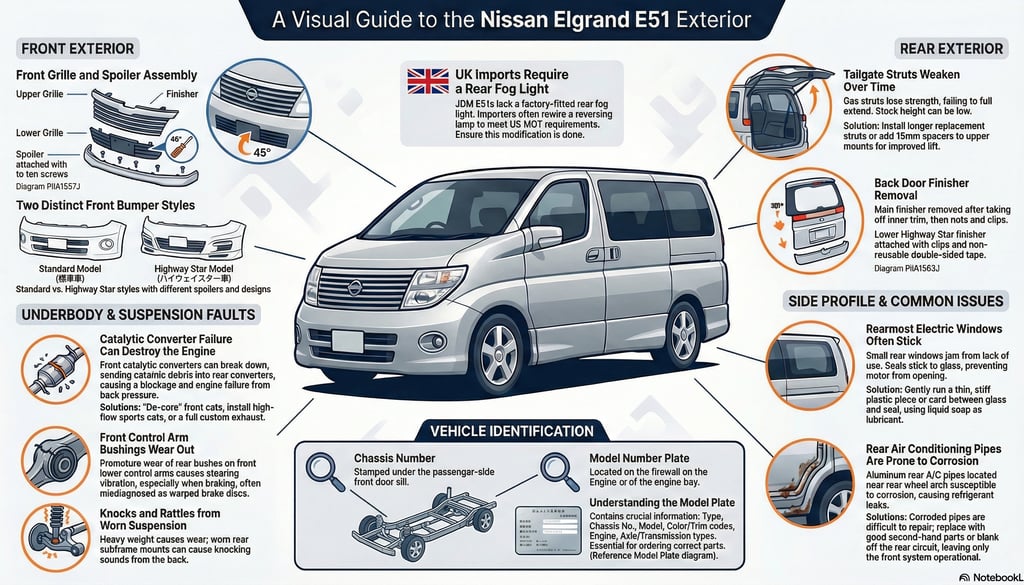
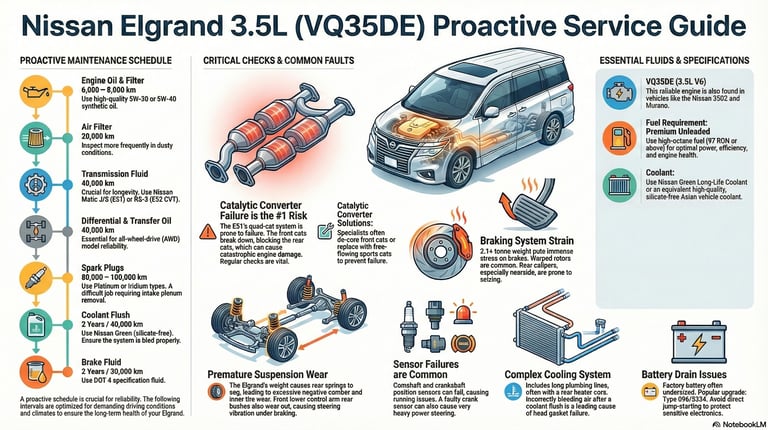
The "E51 beginners guide" clearly describes the issue. The Elgrand features a dual-circuit air conditioning system to provide climate control to both the front and rear passengers. This system relies on a set of aluminum pipes to feed refrigerant to the rear evaporator. The design flaw lies in the placement of these pipes; they are routed near the rear wheel arch, exposing them to moisture, salt, and road debris. Over time, this exposure can lead to significant corrosion. Eventually, the pipes can corrode through completely, allowing the refrigerant gas to leak out and causing the entire air conditioning system to fail. Protecting these pipes or inspecting them carefully before purchase can prevent a very costly future repair.
--------------------------------------------------------------------------------
5. Your Light Switch Doesn't Actually Switch on the Lights
In a modern, electronically complex vehicle like the Elgrand, even the most basic components don't work the way we might assume. Take the light switch, for example. You pull the stalk to turn on the fog lamps, and they light up. It seems like a simple, direct connection, but the "Lighting System.pdf" service manual reveals a much more sophisticated process happening behind the scenes.
The combination switch—the stalk on the steering column for headlights, wipers, and fog lamps—doesn't directly complete a high-power circuit to the lights. Instead, it operates as a low-power input device for a central control unit. When you turn the fog lamp switch ON, it simply completes a contact that sends a signal to a control unit called the "driver C/U". The C/U detects a specific change in voltage on the corresponding input line and interprets this as a command to turn on the fog lamps. Only then does the C/U activate a transistor (OUTPUT4) which sends power to the actual fog lamp circuit.
This might seem overly complicated, but it represents a foundational shift from analog to digital control. This approach not only enables complex features like auto-lights but also simplifies wiring, reduces potential points of failure in high-current switches, and allows for the kind of system-wide diagnostics we saw in Secret #2. It’s a perfect example of how deeply integrated electronic controls are in every aspect of the vehicle's operation.
-------------------------------------------------------------------

Contact
Support
kl8@kl8.au or kl8tech@gmail.com
© 2025. All rights reserved.
Kl8 Family
kl8.au